Existing features can be edited, usually by copying them to a temporary layer, editing them there, then validating them and importing them back to the original data set.
When you edit a feature, it is locked to prevent other users from editing it at the same time. The feature remains locked until you save it, reload the workspace, or end the current session.
If you try to edit a locked feature, a message informs you that the feature is not available for editing. You will have to wait until the feature is available again.
A feature that is superselected for editing may share some of its geometry with other features. If the Shared Edit command is active, changes made to the superselected feature are applied to all features sharing the modified geometry.
Features may fail to be edited if they would have an invalid geometry after the edit or if the changes cannot be shared unambiguously.
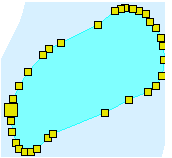
A feature is edited using the Edit Mode command. When this command is active, superselected features are shown with yellow squares representing vertices and nodes.
A node is the point where two edges meet. A node is represented as a larger yellow square.
Point features have a single yellow square, representing the actual position of the point.
When a vertex is selected, it turns red. You can select single or multiple vertices.
When a feature is selected, information is displayed in various windows, including the following:
• Selection window: Displays the feature ID, acronym, and other information about all selected features. You can sort the selection, superselect a feature, deselect features, and zoom in on specific features.
• Components window: Displays the components of the superselected feature. If you select a component, it is highlighted in the Display window.
• Coordinates window: Displays the coordinates of the vertices of the selected feature or component. You can change the shape or position of the feature by editing the coordinates.
• Attributes window: Displays the attributes of the selected feature. You can define or modify these attributes.
Keyboard shortcuts
The following keyboard shortcuts can be used.
Key | Purpose | Mode |
|---|---|---|
Ctrl+Click | Add a vertex on an edge if the pointer is over the edge segment. | Edit |
Ctrl+Z | Undo the most recent action. | Edit |
Enter | Process a change to an edge (for example, when redigitizing an edge segment). | Edit |
Ctrl+E | For an existing and selected digitized feature, enter or exit editing mode. | Edit |
Delete | Delete a vertex. | Edit |
F | Filter selected vertices. | Edit |
M | Merge an edge at a selected vertex. | Edit |
O | Smooth an edge. | Edit |
P | Spatial split at a selected vertex. | Edit |
R | Redigitize selected vertices. | Edit |
S | If manual snapping is enabled, pressing <S> snaps the pointer to the nearest node. To cycle through the multiple vertices, if applicable, press <Space>. | Digitize |
Space | Toggle between vertices when using snapping. | Edit |
The following keyboard shortcuts can be used to select vertices.
Key | Description |
|---|---|
Home | Select the first vertex in a line. |
End | Select the last vertex in a line. |
Shift+Home | Select all vertices from the selected vertex to the start of the line. |
Shift+End | Select all vertices from the selected vertex to the last vertex. |
Down Arrow/Right Arrow | Move the selection forward one vertex. |
Up Arrow/Left Arrow | Move the selection back one vertex. |
Shift+Down Arrow/Right Arrow | Move the selection forward one vertex adding to the selection. |
Shift+Up Arrow/Left Arrow | Move the selection back one vertex adding to the selection. |
Related commands
• • • • • • • • | • • • • • • • |